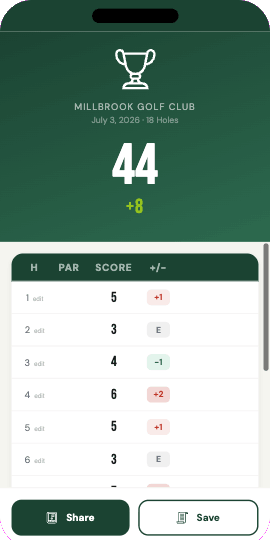
You hit a good drive. You spend the walk replaying it, then wondering whether your partner saw it, then wondering whether you closed the garage door. You chip on, two-putt, pick the ball out of the cup, and realize you have no idea what you just shot.
If that is you occasionally, you are a golfer. If that is you on every hole of every round, and you have spent years being told to concentrate harder, then this page is about something that has a name.
Why the count vanishes
Strip a hole of golf down to its cognitive parts and it is a strange assignment. Over ten to fifteen minutes you have to judge distance and wind, pick a club, execute a swing, track a small ball across a large sky, walk several hundred yards holding a conversation, find the ball, replan and swing again. And underneath all of it, golf adds one quiet background job: hold a number in your head and increment it, without ever being reminded to.
That background job is not really a memory task. It is a prospective memory task: holding an intention across a long, interrupted interval and acting on it at the right moment, unprompted. Prospective memory is the thing that fails when you walk into a room and forget why, and it accounts for the majority of everyday memory failures in general.
It is also one of the things that is measurably harder if you have ADHD. Adults with ADHD show impairment on complex prospective memory tasks. Everyday prospective memory failures are common enough in ADHD to partly explain the link between ADHD symptoms and procrastination. And when researchers built a naturalistic test, a 3D environment where adults carry out ordinary household chores from memory, adult ADHD showed clear deficits in exactly that kind of hold-it-while-you-do-other-things behaviour.
The problem goes deeper than prospective memory alone. Even the act of encoding a number into working memory is compromised: a study using EEG found that adults with ADHD allocate fewer attentional resources during encoding, and fail to distinguish relevant from irrelevant information during retrieval. The deficit is not one of capacity. The hardware is fine. The problem is executive attention, the part of the system that decides what matters right now. On a golf course, everything competes.
A golf hole is that test, outdoors, with a hawk overhead and someone telling you about their new driver.
So the number is not forgotten. It is overwritten. It was never going to survive the walk to the green, and no amount of resolving to pay more attention on the next tee is going to change that. Which you already know, because you have tried it every round for years.
Roughly 15.5 million American adults have a current ADHD diagnosis, and more than half of them were diagnosed in adulthood. A great many golfers have spent a long time blaming their character for something that has a research literature.
Is golf good for ADHD?
This is the question people actually search for, so here is the honest answer, including the parts that are inconvenient for us.
What the evidence supports: physical activity, exercise and sport improve executive function in people with ADHD. A systematic review of young people with ADHD found that even a single twenty-minute bout of activity improves executive function. A systematic review of adults with diagnosed ADHD found that across ten studies, nine reported improved inhibitory control, six improved selective attention, and three improved cognitive flexibility. That is a reasonably consistent picture.
A 2023 meta-analysis of 24 studies (914 participants) confirmed it across three core executive functions: inhibitory control, working memory and cognitive flexibility all improved with physical activity interventions. And a separate meta-analysis found that even a single exercise session, one round, one walk, one swim, yields measurable improvements in core ADHD symptoms and executive function. You do not need a sixteen-week programme.
What the evidence says about golf specifically: a 2024 study in Frontiers in Psychology put 63 university students into three groups, golf, football, and a sedentary control, and trained the first two for sixteen weeks. The golf group significantly improved inhibitory control (p = 0.02). The football group did not. The control group did not. That was a surprise, because golf is a closed-skill sport, and closed-skill sports were assumed to be worse for executive function than open-skill ones. The assumption did not hold.
That golf study was not run on people with ADHD. It was university students, the effect was small (d = 0.26), and a single 63-person quasi-experiment is a starting point, not something you build a health claim on.
So: golf does not treat ADHD. SimplyStroke does not treat ADHD. Anyone selling you either of those is selling you something. What can be said honestly is that golf is exercise, exercise appears to help executive function in ADHD, and golf turned out to be better for inhibitory control than the researchers expected. That is a smaller claim. It is also a true one.
What ADHD golfers actually say the hard part is
Here is a check worth doing on anything written about ADHD and golf, including this page: go and read what ADHD golfers say when somebody asks them directly.
The r/golf threads on this are large, honest and heavily upvoted, and the answers are consistent. The hard part, as they describe it, is not arithmetic. It's object permanence and dead time:
- “Anyone see where that landed?” Losing the ball is the number one complaint, by a distance. One golfer put it perfectly: they watch the ball land, think it's over there by the two trees, help a partner find theirs, and then have no idea where their own ball went.
- Pace of play. Ready golf is the only rhythm that works; anything slower falls apart.
- Waiting. When the course backs up, focus goes, and the tee shot that follows the wait is the one that gets ruined.
- Losing clubs and rangefinders. Expensive, and constant.
And the other thing those threads are full of, which matters more than any of it: golfers with ADHD overwhelmingly love golf. The most upvoted sentiment in the whole conversation is a man saying a round of golf is often the most calmly focused he'll be all week. Golf is described as the zen, not the affliction. Nobody in those threads wants to be told their brain is a problem to be solved, and we're not going to be the ones to tell them.
So take the count for what it is: a small, annoying, genuinely solvable piece of admin that golf never needed to hand you. Not a diagnosis, not a deficit, and not the most interesting thing about how your brain plays this game.
What actually helps on the course
None of this is treatment. It is just what works when the thing going wrong is a golf course, not a brain.
- Count out loud, on the swing, not after it. Externalizing beats rehearsing. Saying “three” as you hit is a physical act. Holding “three” in your head is a task competing with a hawk.
- Settle the number before anyone putts. Not on the next tee, when the hole has already turned from a memory into a story. Your playing partners are an underused external hard drive and they do not mind being asked.
- Pick one pre-shot routine and never vary it. A fixed routine is a scaffold. It is the least interesting part of golf, which is exactly why it works.
- Look at the ball for longer than feels necessary. This one has real evidence behind it. “Quiet eye,” a prolonged, stable gaze on the ball before the stroke, improves putting under pressure and lowers state anxiety. It is concrete, trainable, and has nothing to do with our app.
- Say where the ball went, out loud, before you move. The single most-cited ADHD golf problem is losing your own ball after helping someone find theirs. Naming the landing spot out loud (“left of the second bunker, past the cart path”) makes it a spoken fact instead of a mental note, and spoken facts survive a detour.
- Pick a landmark, not a spot. “Somewhere over there” evaporates. “In line with the tallest tree” does not.
- Play ready golf, and say so on the first tee. Dead time is where the round comes apart. A group that knows you'd rather keep moving will usually just keep moving.
- Count your clubs at every green. Every one. Make it a ritual attached to an event you can't skip, rather than a thing you intend to remember. Rangefinders are expensive.
- Stop being the scorekeeper. Not because you are bad at it. Because it is a job nobody should have been handed in the first place.
Offloading the count
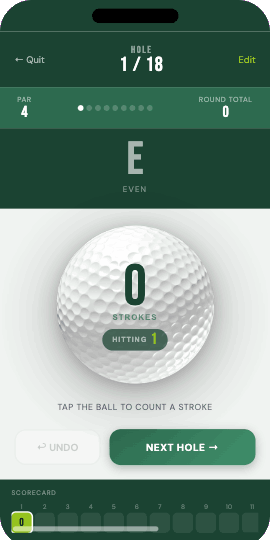
Every fix that reliably works has the same shape: move the task out of your head, and make the capture so small that it survives being uninteresting. One action per swing, not per hole. A target you can hit without looking. Instant feedback that it registered. An undo for honest mistakes. And nothing else on screen competing for attention you were already short of.
That is the design brief SimplyStroke was built to. The whole screen is one golf ball. Swing, tap, forget, move on.